
How to Read a Japanese Auction Sheet
What is an Auction Sheet?
An Auction Sheet is one of the most important tools for buying a car in Japan. It’s where you’ll find detailed information about a vehicle’s condition — everything from mechanical issues to cosmetic damage. Every vehicle sold at Japanese auctions comes with an Auction Sheet.
Robust Auto translates auction sheets into English for all of our customers, so you can make informed decisions without needing to read Japanese.
Becoming confident in reading auction sheets takes time and practice. We recommend bookmarking this page and revisiting it often as you continue to build your skills.
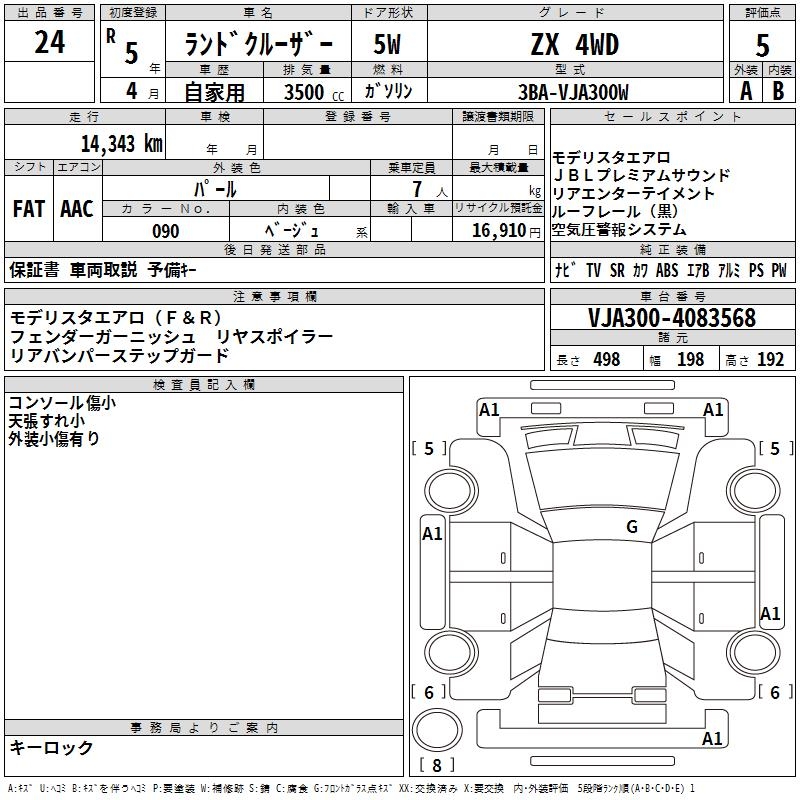
Here’s Our Translated Version
- 2023 Toyota Land Cruiser ZX
- 3500cc/AT/ 4WD
- Fuel Type – Gasoline
- Grade 5
- Exterior A/ Exterior B
- 14,343 km
- Navigation, Leather seats, Airbags, Alloy wheels, AAC, Tv, SR, PS, PW
- Color – Exterior black/ Interior Beige
Sales points
- Purchased from user
- Modellista Aero
- JBL Premium sound system
- Rear Seat Entertainment Sytem
- Black Roof Rails
- Tire Pressure Monitoring System (TPMS)
Notes
- Modellista Aero (Front and Back)
- Fender Garnish
- Rear Spoiler
- Rear Bumper Step Guard
Reports
- Minor Scratches On Center Console
- Minor Scuffs on Headliner
- Minor Exterior Scratches
Diagram Notes
- A1 – Minor scratches on the front bumper (left and right side), Rear bumper (right side), Side skirts (left and right)
- G – Windshield chip
- Scale of tire condition 7 – 8 (brand new or nearly new tires with excellent tread depth,)
- 5 – 6 (Good condition with plenty of life left for driving)
Here’s What a Typical Auction Sheet Looks Like
Auction Grade Explanation
Every vehicle at auction is assigned an “Auction Grade“—a numerical rating that reflects its overall condition. These grades serve as a useful starting point for narrowing your search.
Keep in mind that grades can vary slightly between auction houses and inspectors due to differences in assessment standards.
A high grade never replaces a detailed condition review. Even a vehicle rated 4.5 may carry hidden mechanical issues, accident history, or interior wear. Always rely on a fully translated auction sheet and professional evaluation before placing a bid—never on the grade alone
5
An excellent or near-perfect vehicle in outstanding condition. Cars at this level typically show minimal wear and require little to no reconditioning. Grade 5 vehicles over 10 years old are exceptionally rare, making them highly sought after when available.
4.5
An excellent vehicle for its age. These cars have very few defects, and any present are typically minor or easily repaired. Grade 4.5 vehicles older than 15 years are uncommon, making them a strong choice for buyers seeking quality with minimal reconditioning.
4
A vehicle in above-average condition for its age. These cars may show minor cosmetic wear—such as slight paint fade or a few medium-sized dents—but remain solid overall. Mileage is typically around 100,000 km or lower, making Grade 4 a reliable balance of quality and value.
3.5
The most common grade at Japanese auctions. These vehicles can be in genuinely good condition, but careful review of the condition notes is essential. Possible issues include cigarette burns, larger dents, peeling paint, or noticeable scrapes. Mileage typically falls between 100,000 and 200,000 km. With proper inspection, Grade 3.5 offers solid value for budget-conscious buyers.
3
Grade 3 covers a broader range of conditions and requires extra scrutiny. A vehicle may receive this grade for one of several reasons: overall poor condition, a significant issue such as rust or mechanical trouble, or a minor accident history that does not qualify as “R Grade” because no frame repair was performed. A full translation and careful review of the condition notes are essential before considering any Grade 3 vehicle.
2
Grade 2 vehicles are in very poor condition and are often suitable only for parts. They commonly exhibit severe rust, including holes in the floorboards, body panels, and frame sections. We generally do not recommend these vehicles unless the buyer has specific experience handling cars in poor condition.
R
R Grade cars are widely misunderstood. To be clear: an R Grade vehicle is simply a car that has been repaired after an accident—it is not a “salvage title” or “written-off” car. The original damage could have been minor or major, and outcomes vary: some R Grade cars are outstanding values, while others should be passed over. The key is the auction sheet, which clearly notes every repaired and damaged area. With a full translation and expert review, R Grade cars can be a smart way to access quality vehicles at a lower price.
***
These vehicles are ungraded and have not undergone a standard inspection. They are typically accident cars that were never repaired, or vehicles with other serious problems. In most cases, Grade 0 vehicles are not in running condition and are intended for experienced buyers, dismantlers, or parts sourcing.
What about the interior and exterior grades?
In addition to the overall number grade, auction sheets include separate letter grades for the interior and exterior, rated from A (best) down to D or lower. These letters offer a quick snapshot of cosmetic condition. However, like the overall number grade, they are only a starting point—not enough on their own to decide whether a car is worth bidding on. For the full picture, you’ll need to review the report and diagram sections, which are explained further below.
A
Top-notch condition. A vehicle at this level shows minimal to no wear and presents almost like new. Grade A is quite rare on vehicles older than 10 years, unless they have been exceptionally well kept.
B
A strong, dependable rating. Interiors at this level are very nice, with only minor wear to expect—perhaps some dirt, a worn steering wheel, or a used shift knob. Nothing serious or in need of repair. Grade B offers excellent condition without the premium of a top-tier Grade A.
C
This is where careful inspection truly pays off. Many cars 15 years and older are rated Grade C, and condition varies significantly. For some auctions it’s the lowest grade; for others, it’s far from bad. We’ve seen Grade C interiors that range from excellent to poor. The key is the report section—review it closely (with a full translation) to know exactly what you’re bidding on.
D
E
Grades D and E are not used by the larger auction houses, and they are exactly what you would expect at the lower end of the scale. These vehicles typically show significant interior wear, including cracked dashboards, sagging headliners, ripped seats, stains, or missing interior sections. A thorough review of the report and diagram is essential before considering any vehicle at this level.
Options
SR
Sunroof
AW
Alloy Wheels
PS
Power Steering
PW
Power Windows
AB
Airbag
Auction Sheet Reference Map
1 Mileage
Shows the vehicle’s mileage and whether it’s authentic. Spot a *, $, or # next to the number? That means the mileage isn’t verified.
2 Notes
A note spot for sellers—like why mileage is unknown or if something’s broken. Often used as an extension of Sales Points.
3 Report
This is the most important part of the sheet. The auction inspector lists all damage here—and more text usually means more damage. We fully translate this section, so be sure to review our translation carefully.
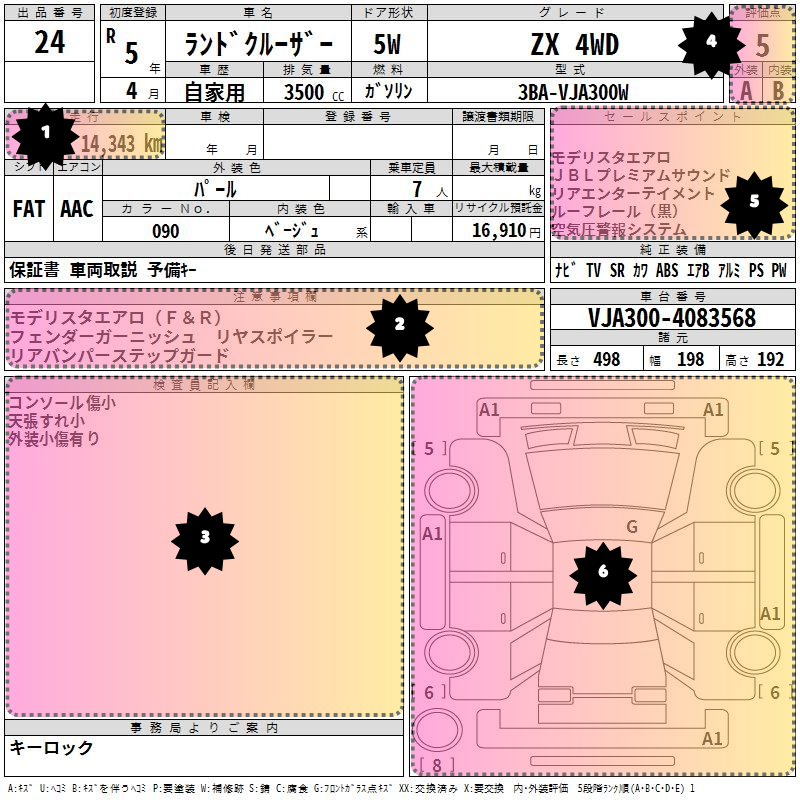
4 Auction Grade
This is the car’s final grade, given by the auction inspector after the full inspection is done.
5 Sales Points
This section is written by the seller and fully translated by our team. It’s where the seller lists the vehicle’s positive features and selling points.
6 Diagram Notes
Review this section carefully—it reveals the true condition of the vehicle’s body far more reliably than photos alone. You’ll need to understand markings such as A1, U2, P3, etc. A key is provided below, and any Japanese text will be fully translated for you.
The information on an auction sheet is extremely important — that’s why we translate it in full, without missing any points, no matter how subtle.
A word of caution: not all exporters translate auction sheets completely. Some intentionally omit important notes to increase the chances of winning a bid on your behalf — leaving you unaware of issues that could affect the vehicle’s condition or value.
Accurate translation takes time and requires qualified, experienced professionals to do it correctly. We believe you deserve to know everything about a vehicle before bidding, so we never cut corners. If anything on a translated sheet is unclear, please don’t hesitate to ask — we’re always happy to explain.
Diagram notes section
Defect symbols are placed on a car diagram within the auction sheet, indicating the exact location of each imperfection. Below are the main symbols you’ll typically encounter. While individual auction venues may occasionally use rarer or house-specific codes, these symbols cover the vast majority of auction sheets.
The Basics
Each type of damage is represented by a letter. For example, <A> typically indicates a scratch or chip.
Many letters are followed by a number, which indicates the severity of the damage. For example, A1 – small line scratch, A2 – medium, A3 – large and A4 would indicate very larger or more noticeable line scratch.
A
Scratch or Chip
A1 – These are minor surface scratches that can typically be polished out and are nearly invisible once addressed. They are generally not a cause for concern. (~10 cm)
A2 – Line scratch — medium (~20 cm)
A3 – Line scratch — large (~40 cm)
A4 – Line scratch — very large (Larger than A3)
U
Dent
U1 – Like A1, these are minor dents that are usually too small to notice unless you’re specifically looking for them.
U2 – Dent — medium (Golf-ball size dimple)
U3 – Dent — large (Tennis-ball size to Soccer-ball size)
B
Dent + scratch
B1 -Dent with scratch — small (roughly golf-ball sized.)
B2 – Dent with scratch — medium (Tennis-ball size combined)
B3 – Dent with scratch — large (Soccer-ball size combined)
W
Repair mark
W1 – A professionally repaired area with minimal to no visible trace of the original damage.
W2 – Indicates that the panel has been repainted or repaired. This is typically a good-quality repair — a trained eye may be able to detect subtle differences in the paint, but most buyers are unlikely to notice.
W3 – Indicates a low-quality repair, often involving heavy use of putty or filler. These areas typically require re-repair to bring them up to an acceptable standard.
P
Paint Damage
P1 – Light fading or minor peeling limited to a single panel.
P2 – Fading or partial peeling affecting multiple panels.
P3 – Extensive fading or peeling requiring a full panel repaint.
P4 – Widespread paint failure exceeding the P3 threshold.
S|C
Rust/Corrosion
Rust is graded S and C1–C4.
S/C1 – On the body = minor surface rust (stone chip or sunroof edge) usually easy to fix.
But S in the negative comments can mean serious underbody rust, while C on the wheel arches often signals heavy corrosion from snowy roads.
S2/S3 – Heavier, more advanced rust that may require remediation or affect structural integrity.
X
Replacement required
Panel flagged as requiring full replacement rather than repair.
XX
Replaced
Indicates a part such as a door, fender, or bumper has already been replaced. This does not count toward the vehicle’s repair history.
G
Glass chip
You may see a G, X, or A marked on the windshield in the diagram. This typically indicates a small stone chip or scratch — often no larger than a pinhead and barely visible.
These are common marks that most vehicles pick up through normal use, and their presence doesn’t necessarily mean the windshield needs replacing.
Y
Crack or Tear
Inspectors pair the letter Y with a number from 1 to 3 (or sometimes 4) to indicate the size of the crack or tear.
Y1 – A small crack, hole, or tear, typically 2 to 3 cm in size (roughly thumb-sized).
Y2 – A medium crack or tear, under 10 cm in size (roughly palm-sized).
Y3/Y4 – A large crack, hole, or major tear exceeding 10 cm in size.
修復歴 (Shufuku-reki) — Repair History
A vehicle is designated with 修復歴 (shūfukureki, translated as “repair history”) solely in instances where one or more of the eight core structural components have undergone repair or replacement. This definition is established by JAAI (Japan Automobile Appraisal Institute) and serves as the industry-wide standard.
The Eight Core Structural Components
- Front and rear side members
- Pillars (A, B, or C pillars)
- Dash panel
- Cross member
- Radiator core support (welded type only)
- Roof panel
- Floor or trunk floor
- Inner panel
It is important to distinguish between cosmetic bolt‑on panel repairs and structural repair history. Repaired or replaced bolt‑on components — including doors, fenders, hood, trunk lid, and bumpers — do not constitute 修復歴 (shūfukureki).
A vehicle marked “XX” on a fender is not automatically classified as a 修復歴 vehicle. The definitive indication of repair history is an auction grade of R or RA.
Frequently Asked Questions
It is natural to have ongoing questions as you familiarize yourself with the process. Kindly allow yourself time to develop proficiency. We welcome any inquiries via email; however, we invite you to first review the frequently asked questions provided below.
Think of the auction as a neutral middleman. They’re not tied to the seller, and they get paid whether the car sells or not. Plus, with over 100 auction houses in Japan, competition is fierce—if their inspections weren’t reliable, buyers would go elsewhere fast.
Absolutely. Through Robust Auto, we review and translate the original auction sheet before every bid and share the key findings with you. Sheet review is included as part of our standard buying support, so you never have to bid blind.
The simple answer is yes. However, it’s important to know that some vehicles at auction have unverified mileage. The auction sheet will always indicate this. Check next to the mileage for the symbols *, #, or $ — these marks mean the mileage has not been confirmed. Our full English translation will always make this clear as well.
While photos are useful for a general impression, be careful — they don’t always show the vehicle’s true condition. Make it a habit to review the auction sheet body diagram in detail. The diagram is the inspector’s precise map of damage and wear, and it tells you far more about the car’s real quality than pictures alone.
If you want to bid directly, yes — you’d need a Japan‑registered business, a kobutsusho (used article dealer) license, and Japanese‑speaking staff. But as an overseas buyer, you don’t need any of that. Just work through a Japanese agent like Robust Auto, and we handle the bidding on your behalf.
The auction sheet is completed by two parties: the seller and the auction inspector. The seller provides the vehicle information, sales points, and seller notes, while the inspector prepares the condition report and body diagram notes. The inspector also verifies the accuracy of the information supplied by the seller.
Occasionally, inspectors may miss something on the auction report. When this occurs, we can file a claim with the auction house. Provided the auction accepts the claim, you may receive either a monetary refund or the option to return the vehicle. Please note that vehicles over 10 years old typically do not qualify for condition-related claims.
An R grade (R点) indicates that the vehicle has 修復歴 (structural repair history), meaning one or more of the eight core frame components has been repaired or replaced. While the vehicle may drive normally after proper repair, this history is disclosed so buyers can factor it into their pricing. RA (RA点) represents a lighter variant of the R grade.